There is a distinct romance to a railway line that begins beneath the grand glass roof of a major city terminal and ends at the edge of the ocean. The route from Glasgow city centre to Ardrossan is a journey that captures the very essence of the Scottish Lowlands. It transitions seamlessly from Victorian industrial might to rolling Renfrewshire hills, before opening up to the salty air of the Ayrshire coast.
Operated by ScotRail, this line is a lifeline for commuters, but for the leisure traveller, it acts as a portal. It whisks you away from the urban bustle and deposits you right next to the ferry terminal for the Isle of Arran, or simply invites you to enjoy a bag of chips on a windy promenade. Whether you are a railway enthusiast, a beach lover, or a history buff, this short but varied line has plenty to offer.
What makes this route special
The beauty of the Glasgow to Ardrossan line lies in its variety. In under an hour, you experience a cross-section of Scottish life. You start in the architectural splendour of Glasgow Central, traverse the historic weaving town of Paisley, skirt the edge of beautiful nature reserves, and finish with views across the Firth of Clyde.
It is a route of anticipation. For many, the train is the start of a holiday, bound for “Scotland in Miniature”—the Isle of Arran. But even if you keep your feet on the mainland, the “Three Towns” of Stevenston, Saltcoats, and Ardrossan offer a rugged coastal charm that feels a world away from the city centre. It is a reliable, frequent, and incredibly scenic corridor that connects the River Clyde to the open sea.
A breakdown of the journey
The journey begins at Glasgow Central, one of the UK’s most impressive stations. As the train winds its way out of the city, you pass through the immediate suburbs including Cardonald, and the twin stops of Hillington East and Hillington West, which serve key business and industrial hubs.
The first major highlight is Paisley. As the train arrives at Gilmour Street (the fourth busiest station in Scotland), look out for the spires of the town. Paisley is steeped in history, famous for its pattern and its weaving heritage, and is home to the magnificent Paisley Abbey.
Moving further west, the line passes through Johnstone, a town designed on a grid system, followed by the quieter stops of Milliken Park and Howwood.
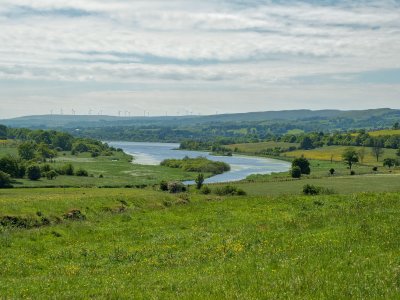
The scenery shifts noticeably as you approach Lochwinnoch. Here, the railway runs alongside Castle Semple Loch. On a clear day, the water glitters beautifully, and you can often spot swans and rowers enjoying the calm surface. It is one of the most picturesque segments of the line.
Crossing into North Ayrshire, the train stops at Glengarnock and Dalry, historic towns surrounded by green pastoral land. You then reach Kilwinning. This is an important railway junction where the line splits (one way to Ayr, the other to Ardrossan/Largs). Kilwinning itself is famous for its ancient abbey ruins, which are well worth a visit.
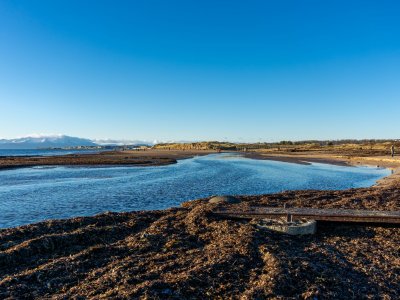
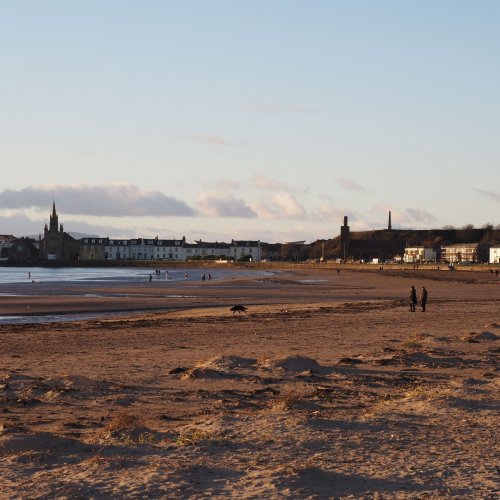
Finally, you hit the coast—the famous “Three Towns”. First is Stevenston, followed quickly by Saltcoats. Saltcoats is a classic seaside resort; from the train, you can see the town and sense the proximity of the beach. The line terminates at Ardrossan. Depending on your specific train, you will either stop at Ardrossan Town or continue right onto the breakwater at Ardrossan Harbour, where the CalMac ferries await.
When does the route run
This is a vital commuter and leisure corridor, so the service is robust. Trains run daily from early morning until late at night.
- Monday to Saturday: Services generally run every 30 to 60 minutes. During peak times, the frequency increases to handle commuter traffic.
- Sundays: The service runs slightly less frequently, usually hourly, but still offers a consistent connection for day-trippers.
It is important to check whether your train terminates at Ardrossan Town or Ardrossan Harbour. If you are catching the ferry, ensure you board a service marked for the Harbour to save yourself a walk with luggage.
Value for money
Rail travel in this region is generally considered good value, especially compared to driving and parking fees.
- Off-Peak Tickets: If you travel after 09:15 on weekdays (or anytime on weekends), fares are significantly cheaper.
- Kids for a Quid: ScotRail’s popular scheme allows up to four children to travel for just £1 return each with a fare-paying adult, making this an incredibly affordable family day out.
- Railcards: National Railcards (16-25, Two Together, Senior, etc.) apply on this route, offering a further 1/3 off fares.
Top tips for the journey
- Sit on the right: When travelling from Glasgow towards Ardrossan, try to sit on the right-hand side of the carriage. This gives you the best views of Castle Semple Loch at Lochwinnoch and the first glimpses of the sea as you approach the coast.
- Check the destination: As mentioned, the line splits at Kilwinning. Ensure you are on the “Ardrossan” portion of the train, not the “Largs” or “Ayr” portion, as trains sometimes split or passengers can get confused by the different destinations on the departure board.
- Combine with a ferry: Even if you aren’t staying overnight on Arran, you can take the train to Ardrossan Harbour and hop on the ferry as a foot passenger for a “cruise” to Brodick and back. The views of Goatfell mountain from the ferry are spectacular.
Planning a day out on this route
The versatility of this line allows for several different types of days out.
- The Nature Lover: Disembark at Lochwinnoch. A short walk from the station takes you to the RSPB nature reserve. You can spend hours birdwatching, walking the trails around the loch, or enjoying a coffee at the visitor centre.
- The History Hunter: Hop off at Paisley Gilmour Street. Explore Paisley Abbey, the museum, and the Victorian town hall. It is a town with a rich cultural tapestry often overlooked by those rushing to the coast.
- The Beach Goer: Stay on until Saltcoats. It is a traditional Scottish seaside town. You can walk along the promenade, grab an ice cream, play in the amusements, or simply relax on the sandy beach.
- The Islander: Take the train all the way to Ardrossan Harbour. Catch the ferry to Brodick, have lunch at a pub near the port, visit Brodick Castle, and return on the evening ferry and train. It makes for a long but unforgettable day.
Year-round appeal
While the coast is naturally more popular in summer, this route runs 364 days a year (excluding Christmas Day) and has a distinct charm in every season. Winter brings dramatic grey skies over the Firth of Clyde and cosy pubs in Paisley and Ardrossan. Autumn turns the trees around Lochwinnoch a fiery gold. Spring sees the lambs in the fields of Ayrshire. Because the train is warm and comfortable, it is a fantastic way to see the changing face of southwest Scotland without braving the elements until you are ready to step off the platform.